
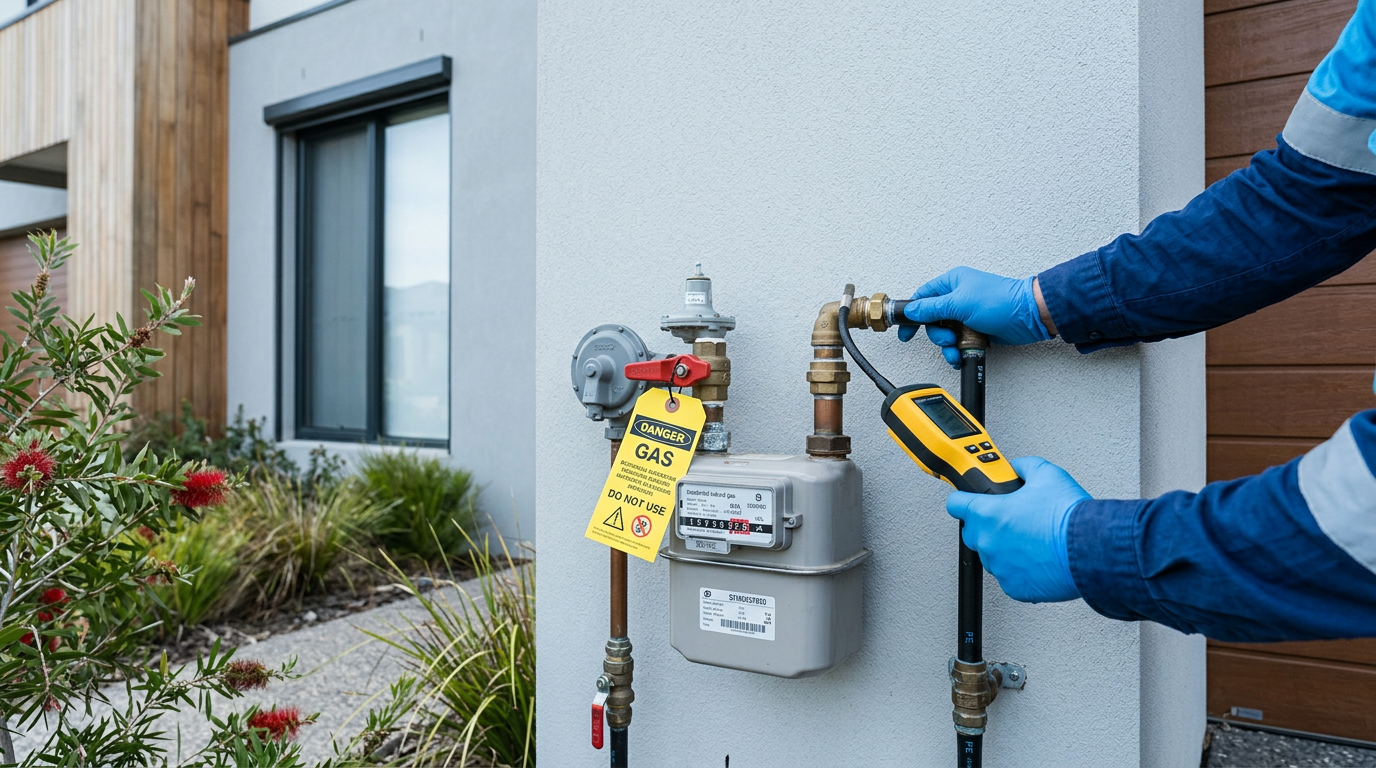
Natural gas and LPG are both odourless by nature. The “gas” smell you recognise is actually a chemical called ethyl mercaptan that’s added deliberately so leaks can be detected by smell. If you ever notice that smell in or around your home, take it seriously. Most gas leaks are minor and easily fixed — but the ones that aren’t can cause explosions, fires and carbon monoxide poisoning.
Immediate action if you smell gas right now
Stop reading. Do this first:
- Do not use any flames, matches, lighters or candles.
- Do not operate any electrical switches — lights, fans, the doorbell, phones. A switch spark is enough to ignite gas at the right concentration. If a light is already on, leave it on.
- Open doors and windows on your way out to ventilate the space.
- Turn off the gas at the meter if it is safely accessible on your way outside — quarter-turn handle, turn perpendicular to the pipe.
- Evacuate the building and go to a neighbour or at least 10m away.
- Call 131 909 (Jemena gas emergency, 24/7) or 000 if you believe people are in danger.
- Then call a licensed gas fitter to diagnose and repair.
Do not go back inside until it’s been cleared as safe.
How to recognise a gas leak — the six warning signs
1. That distinctive rotten-egg or sulfur smell
This is the most common and most reliable sign. Natural gas smells sulfurous because of added mercaptan; LPG smells slightly different but has the same warning odour. A faint whiff near a cooktop or water heater that goes away when you open a window is worth investigating — it shouldn’t happen at all.
2. A hissing sound near a gas line, meter or appliance
Small leaks from a threaded joint or a flared fitting often make a very faint hissing sound when everything else is quiet. Listen near the meter, the hot water system connection and behind the cooktop/oven.
3. Dead or dying plants in a single spot outside
An underground gas leak displaces oxygen in the soil and kills plant roots above it. A patch of dead grass or dying plants in a line across your lawn — especially one that follows the run of a buried gas pipe — is a strong indicator.
4. A hissing or bubbling sound from wet ground
If a buried pipe is leaking hard enough, escaping gas can bubble through wet soil, a puddle or a drain pit.
5. A sudden and unexplained spike in your gas bill
If your gas bill has jumped with no change in usage — no new appliance, same occupants, same season — a slow leak somewhere on the property is a real possibility. Gas bills for typical Sydney households in 2026 are reasonably stable; a 30%+ increase warrants investigation.
6. Physical symptoms — dizziness, nausea, headaches
Mild gas leaks indoors reduce oxygen concentration enough to cause headaches, dizziness, nausea, a metallic taste, or fatigue — often worst in one specific room. If symptoms improve as soon as you step outside, take it as a serious warning. Carbon monoxide (from incomplete combustion, usually a faulty flue on a gas heater or water heater) causes the same symptoms and is substantially more dangerous — it’s odourless and deadly at much lower concentrations.
One rule you can remember: any combination of “gas smell” and “feeling unwell” is evacuate-now-and-call-131 909. Never a judgment call.
How a licensed gas fitter finds a leak
In New South Wales, all gas work — including leak detection and repair — must be carried out by a tradesperson with a Plumbing & Gasfitting licence issued by NSW Fair Trading. We’re required by law to issue a Certificate of Compliance for any gas work we do. Here’s what actually happens on a gas leak callout:
- Isolation test. We close the meter, pressurise the line with a manometer (gauge) and measure pressure drop over 5–10 minutes. Any measurable drop means a leak somewhere in the system.
- Leak locator. Using an electronic gas detector or a foaming leak-detection solution, we work each joint, each appliance connection, and each buried line until the source is identified.
- Repair. Threaded joints get remade with correct gas-rated sealant or PTFE tape. Flared joints get inspected and often replaced. Buried polyethylene (PE) pipes require the section to be cut out and replaced, usually with electrofusion couplers.
- Retest and certificate. Another pressure test, and — assuming zero drop — the line is recommissioned, each appliance is relit, and we issue the compliance certificate.
What gas leak repair work looks like
Pricing for gas leak detection and repair depends on what we find: a simple threaded-joint reseal is a small job; a buried PE pipe replacement under a driveway is a much larger one. We always quote in writing once the leak is located and the access is clear — that way you see exactly what the repair, the pressure-test and the compliance certificate cost before we proceed. After-hours and emergency callouts are charged at a higher rate to cover being on call.
Prevention: small things that matter
- Get a gas safety inspection every 2 years for older systems (gas appliances installed before 2005 especially), every 5 years for newer ones.
- Replace flexible appliance connectors when they reach their stamped expiry date (typically 10 years). They harden and crack after that point.
- Service gas heaters and water heaters annually — not just for efficiency, but so the combustion and flue can be checked for carbon monoxide risks.
- Install a carbon monoxide alarm on each level of the home. They’re inexpensive at any hardware store and have multi-year batteries; there’s no real reason not to.
- Know where your gas shut-off is. Same test as for water: find it today, make sure you can turn it off.
Suspect a leak right now? Evacuate, call 131 909, then call Southern Star Plumbing on 0432 304 609 — our licensed Sydney gas fitters do leak detection, repairs and certification across the metro area. Or book a gas safety inspection for peace of mind.