
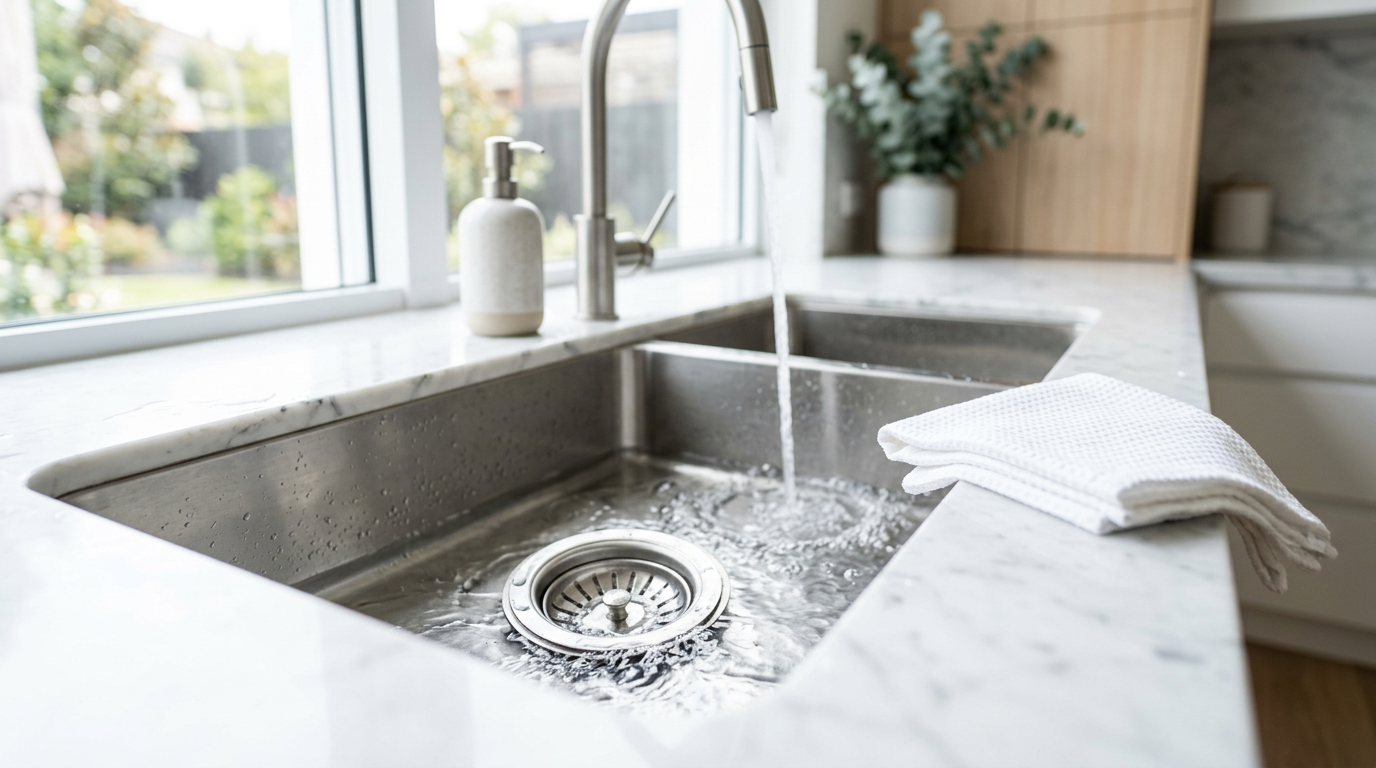
That sour, sulfuric, slightly rotten smell drifting up from the kitchen sink or shower drain is one of the most common questions we get asked. It’s easy to assume it’s just “dirty” and the problem is the pipe — but in reality it’s almost always one of six specific causes, each with its own fix. Work through them in order and most people solve the problem in under an hour.
1. A buildup of food, fat or hair in the trap
The U-bend or bottle-trap under every sink and shower is designed to hold a small reservoir of water that stops sewer gas coming back up — but it’s also a catch-point for anything solid that gets past the drain screen. In kitchen sinks that means grease, food scraps and coffee grounds. In bathrooms, hair and soap scum. Both break down anaerobically over time and produce the classic rotten-egg smell of hydrogen sulfide gas.
The fix: For a bathroom basin or shower, unscrew the trap under the sink (have a bucket ready), tip out the gunk, scrub with hot water and a drop of dishwashing liquid, and reassemble. For a shower floor waste, a drain snake or even a bent coat hanger will pull out a surprising amount. Follow with a kettle of hot (not boiling) water and half a cup of bicarb soda followed by a cup of white vinegar — the classic kitchen foam — then flush with hot water after ten minutes. Do this monthly and you’ll never smell it again.
2. A dry P-trap (the weekender smell)
The water sitting in the trap evaporates if a fixture isn’t used for a couple of weeks. Dry trap = no seal = sewer gas straight into the room. If the smell appears after you’ve been on holiday, in a rarely-used bathroom, or around a floor waste in the laundry that never gets used — this is it.
The fix: Run water in every sink and shower for 30 seconds, and pour a jug of water down every floor waste. Problem solved. For floor wastes that regularly dry out, a teaspoon of mineral oil floated on top of the water will dramatically slow evaporation.
3. A blocked or missing vent stack
Every plumbing system needs a vent stack — a vertical pipe from the drain system up through the roof that lets sewer gas escape and maintains atmospheric pressure in the drains. If that vent gets blocked (leaves, a bird’s nest, a squashed flange on the roof) or was never properly installed during a renovation, the trap water can get sucked out whenever a large fixture (like a bath or a dishwasher) drains. You’ll hear gurgling, smells will come and go, and it’ll feel worst on still, damp days.
The fix: This is a job for a licensed plumber. We’ll inspect the vent from the roof, clear it if needed, or fit a mechanical air-admittance valve if the original vent is inaccessible.
If the smell is accompanied by gurgling from floor wastes when you run the washing machine, it’s almost certainly a venting problem — not the drain itself.
4. A biofilm inside the drain pipe
Especially in kitchens, a layer of pink, black or grey biofilm builds up on the inside walls of the pipe above the trap. This is a bacterial colony living off food residue and soap. Bicarb and vinegar won’t touch a mature biofilm; you need to scrub it off physically. A flexible drain brush from any hardware store will reach 30–40cm into the drain and is a revelation the first time you use it. For shower drains, the same brush is perfect for clearing soap-and-hair scum from the strainer and first elbow.
5. A hot water system anode issue
A very specific case: if only the hot water from a particular tap smells like rotten eggs but the cold water is fine, the problem is almost always the sacrificial anode in your hot water system reacting with sulfate-reducing bacteria in the tank. It’s especially common with magnesium anodes in soft water. Replacing the magnesium anode with an aluminium or powered anode usually clears it within a day or two. Our guide on replacing your hot water system covers this in more depth.
6. A cracked drain pipe under the slab
The least common, most serious cause. A hairline crack in a drain pipe under a slab or in a wall cavity allows sewer gas to seep into the structure continuously. You’ll smell it strongest near floor-slab joints, power points, or along wall skirtings rather than at a fixture. Damp patches, “musty” smells that come and go with the weather, and recurring drain issues are all clues. Diagnosis requires a smoke test or CCTV camera inspection, both of which a drainage specialist plumber can do.
A realistic troubleshooting order
- Pour a jug of water down every drain (rules out dry trap).
- Clean the trap and pipe with a drain brush.
- Scrub with bicarb and vinegar; flush with hot water.
- If the smell comes back within a week or returns with gurgling — call a plumber to investigate venting or drainage integrity.
What NOT to do
- Don’t pour bleach or caustic drain cleaners down regularly. They do little against biofilm and they’re extremely hard on older PVC joints and galvanised traps. We’ve replaced more than a few traps that were eaten through by well-intentioned DIY.
- Don’t ignore a returning smell. Persistent, recurring drain odour almost always means the underlying issue is structural (venting, cracking, or a partial blockage further down the line) and it will not go away on its own.
Tried the fixes and the smell is still there? Southern Star Plumbing diagnoses drainage issues right across Sydney — we carry CCTV cameras, drain jets and the right diagnostic kit to track it to the source in one visit. Call 0432 304 609 or book an inspection online.