
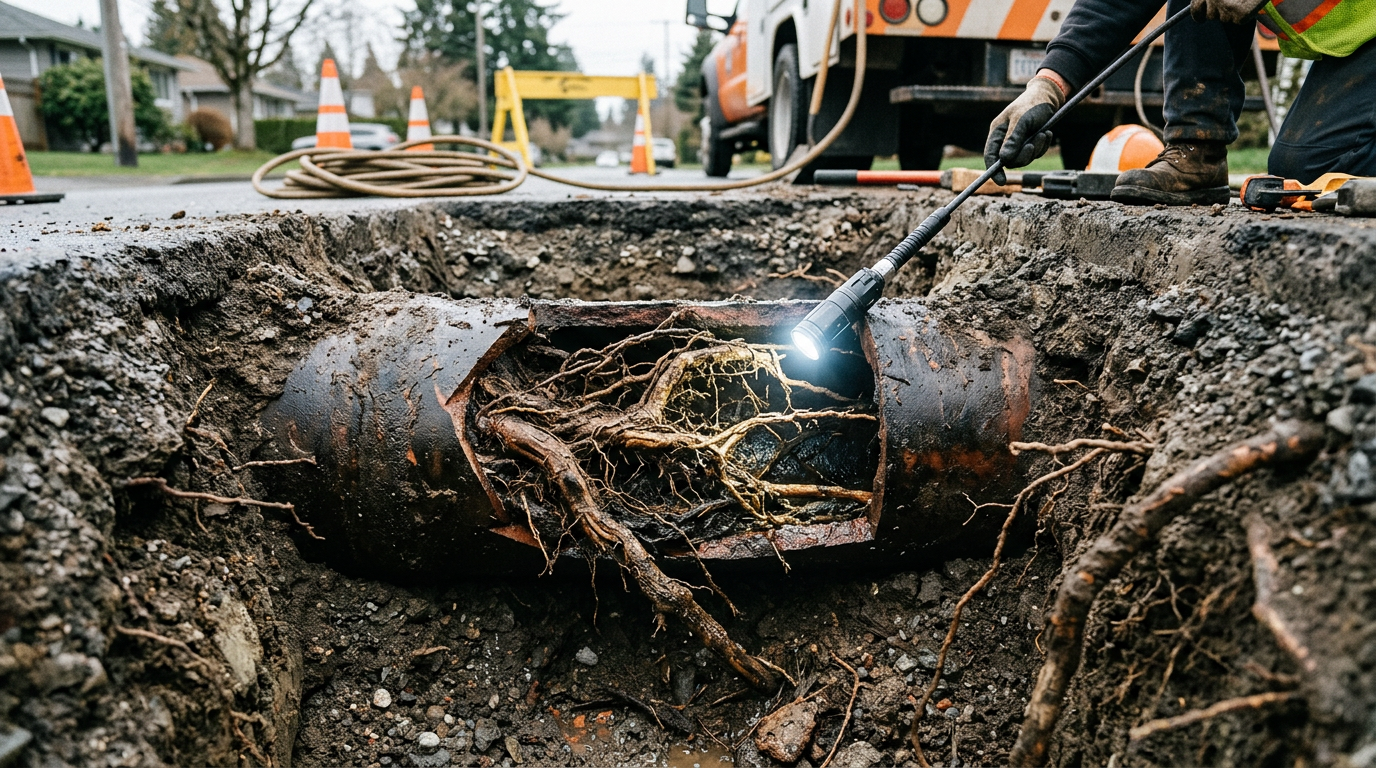
If you live in an older Sydney suburb with mature street trees — Paddington, Balmain, Drummoyne, Chatswood, any of the leafy inner-west or northern suburbs — there’s a better-than-even chance your sewer line already has roots in it. Sydney’s combination of clay soils, old vitrified clay (terracotta) sewer pipes and large, thirsty street trees is almost the textbook worst case for root intrusion.
How and why roots get into sewers
Tree roots don’t “smash” their way into pipes. What actually happens is more interesting. Clay sewer pipes are joined with short sections and sealed with mortar or rubber rings. As the ground shifts over decades, tiny cracks or gaps develop at the joints. Sewer pipes contain a constant stream of warm, moist, nutrient-rich air and water — a combination that evaporates out through any crack. Tree roots grow towards moisture, detect that vapour trail metres away, and send feeder roots to the source. Once a hair-thin root finds its way through a joint, it fans out inside the pipe, which is practically a luxury environment for a root — unlimited water, nutrients, and no competition.
Early warning signs
Root intrusion never starts as a full blockage. It builds up over months or years. Catch it at any of these stages and the repair is straightforward:
- Gurgling from floor wastes or the toilet when a washing machine drains or a nearby shower runs.
- Slow drains across multiple fixtures — one slow sink is usually a local blockage, but several slow drains at once suggests the issue is further down the line.
- A faint sewer smell in the garden, particularly after rain or around the gully trap outside the bathroom wall.
- Unusually green, fast-growing grass in one stripe across an otherwise ordinary lawn — the sewer line is effectively fertilising itself.
- Sinkage or a depression following the line of the sewer — usually a sign the pipe has already collapsed at one point.
- Recurring “blocked toilet” callouts — if you’ve had a plumber out for the same symptom twice in 12 months, it’s almost always roots.
What a plumber actually does to diagnose it
The gold standard is a CCTV drain camera inspection. We snake a waterproof camera down the sewer from the nearest inspection point, record the whole run, and locate every defect with a radio-frequency sonde so the depth and position above ground can be marked on the driveway. A good CCTV inspection will tell you exactly where the roots are (metres from the boundary trap), how bad the intrusion is, and whether the pipe itself is structurally sound or already cracked/collapsed.
The CCTV inspection is quoted as a standalone item and is often credited towards the repair if you proceed.
The options for actually fixing it (cheapest to most permanent)
1. Mechanical cutting / electric eel
A rotating cutter head is fed down the line and mechanically chops out the root mass. Fast, effective short-term, but doesn’t fix the cracked joint the roots grew through — roots typically grow back within 12–36 months. The cheapest of the options.
2. High-pressure water jetting
A drain jetter delivers water at up to 5,000 psi through a rotating head. Removes fine root hairs more thoroughly than mechanical cutting and scours the pipe walls clean. Again, not a permanent fix on its own — but ideal as the “clean first, then assess” step before CCTV.
3. Foaming root herbicide
Commercial foaming herbicides (dichlobenil or metam-sodium based) are introduced after jetting. They kill the root tissue inside the pipe and a short distance into the surrounding soil, without harming the tree above ground. Extends the interval before regrowth to 3–5 years. Typically added to a jet or cut.
4. Pipe relining
A flexible resin-impregnated liner is inverted into the existing pipe and cured in place with UV light or hot water. Result: a seamless, jointless, structurally-sound new pipe inside the old one — zero joints means zero entry points for roots. Pipe relining is the go-to fix for Sydney homes where excavation would mean destroying a paved driveway, a pool surround or a heritage front yard. Typically warrantied for 50 years and priced per linear metre after a CCTV survey.
5. Excavation and pipe replacement
Traditional “dig it up” repair. Sometimes unavoidable — badly collapsed pipes can’t be relined. The most expensive of the options because of the excavation, reinstatement and surface repair. Always get a CCTV survey before accepting a quote to excavate; unnecessary digging is one of the most common rip-offs in the drainage trade.
If a plumber recommends excavation without a CCTV survey and a recording you can watch, get a second opinion. In 2026 there is no good reason to excavate blind.
How to stop it coming back
- Annual jetting: for known affected lines, a yearly maintenance jet keeps roots under control and is cheap insurance.
- Reline before the pipe collapses: a small crack today is far cheaper to reline than a collapsed pipe next year. CCTV every 3–5 years in high-risk homes makes economic sense.
- Don’t plant high-risk species near sewer lines: willows, poplars, figs, oleanders, jacarandas and liquidambars are the worst offenders in Sydney.
- Sydney Water inspection policy: remember that the portion of the sewer line on your property is your responsibility, not the council’s. The council tree that caused the damage doesn’t change that.
What about the street tree itself?
Cutting back or removing a protected street tree usually requires a permit from your local council, and the process can take weeks or months. The good news is that for most homes, pipe relining plus maintenance solves the problem without needing to touch the tree. We’ll advise you if it looks like that won’t be enough.
Recurring drain blockage? Southern Star Plumbing carries CCTV cameras, drain jetters and root cutters in every van — we can usually diagnose and clear in a single visit. Call 0432 304 609 or book an inspection.