
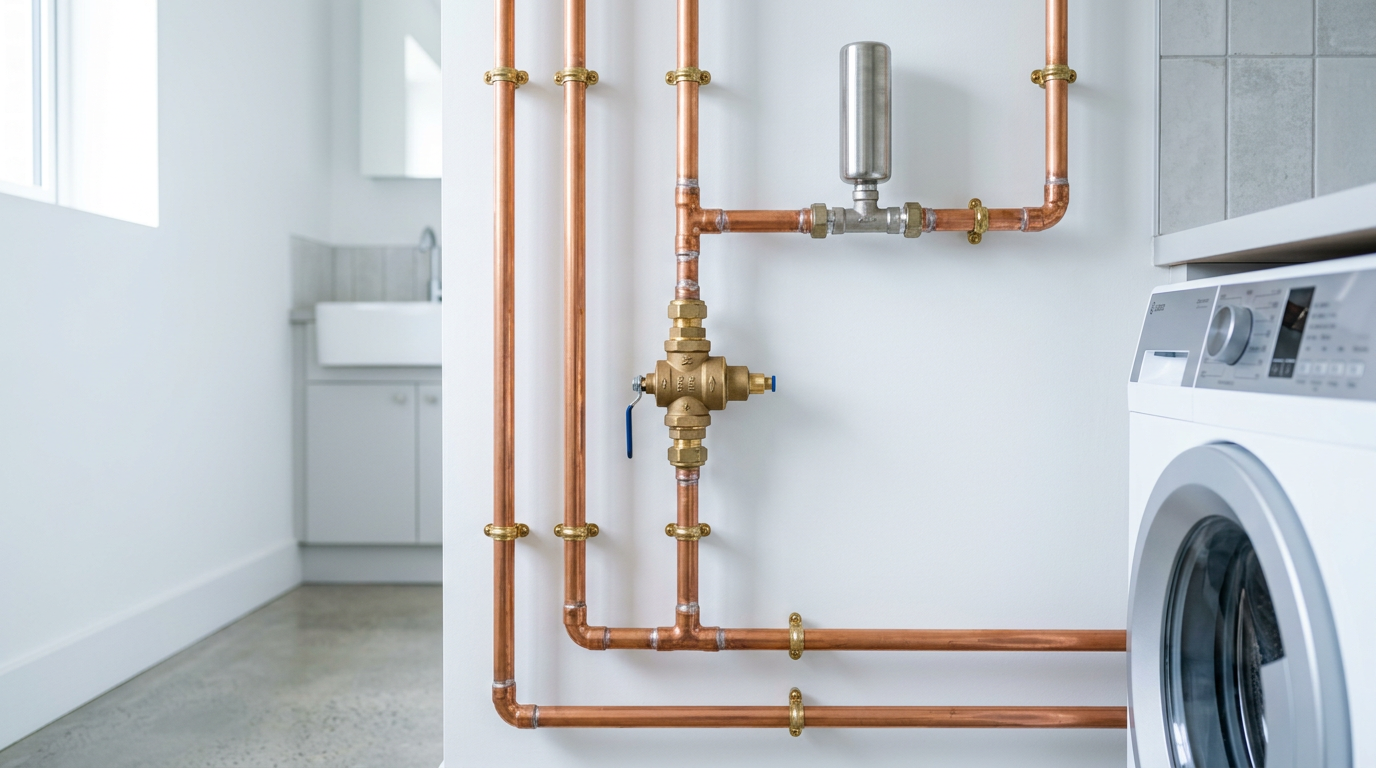
Water hammer is the loud bang, clunk or shudder you hear when a tap closes suddenly, a toilet cistern finishes filling, or an appliance valve slams shut. Most Sydney homes get it eventually. It sounds benign but it’s worth fixing: every bang is the shockwave of several tonnes of momentum slamming into your pipework, and over time it loosens joints, cracks fittings and shortens the life of everything connected to it.
What’s actually happening inside the pipes
When water flows through a pipe and a valve closes suddenly, the moving column of water has nowhere to go. It slams into the closed valve and the pressure spikes — sometimes to five or six times the normal supply pressure — then reflects back up the pipe as a shockwave. That shockwave is what you hear as a bang, and what you feel as a shudder through the wall. The effect is named water hammer because the forces involved genuinely are like being hit with a hammer.
The four most common causes in Sydney homes
1. Fast-closing appliance solenoid valves
Modern washing machines, dishwashers and fridges with ice-makers all use solenoid valves that close in milliseconds. On a long, straight run of copper pipe with no air cushion, that’s almost a textbook case of water hammer. If the bang happens every time a specific appliance runs, this is your culprit.
2. Worn tap washers and jumper valves
An old, worn tap washer doesn’t close cleanly — it slaps. That’s why some taps bang when you shut them off while others don’t. A replacement washer and jumper valve is an inexpensive part plus a few minutes’ work.
3. Excessive mains pressure
Sydney’s incoming water pressure can legally be up to 800 kPa, but most fixtures are rated for around 500 kPa. High pressure magnifies every shockwave. A licensed plumber can measure static pressure at an outside tap in five minutes; if it’s over 500 kPa, a new pressure-limiting valve (PLV) at the mains is usually the single best thing you can do for your plumbing (see our guide on low water pressure for the other side of that story).
4. Loose or unsupported pipework
Pipes that aren’t clipped properly rattle against joists and wall studs when pressure spikes. Sometimes the “water hammer” you hear isn’t strictly the shockwave — it’s a poorly clipped copper pipe vibrating against a stud behind the plasterboard. A skilled plumber can usually narrow this down by listening while someone opens and closes taps.
A good rule: if the bang happens when water starts flowing, it’s usually air in the lines or a worn washer. If it happens when a tap or valve closes, it’s true water hammer.
The fixes — from cheapest to most permanent
1. Reseat the mains cushion (for older homes)
Older Sydney homes often have vertical “air chambers” — capped copper stubs above each fixture that were meant to trap a cushion of air. Over time, the air dissolves into the water and the chambers fill up, losing their cushioning effect. To recharge them: turn off the mains at the meter, open every tap in the house from the top floor down to drain completely, close every tap, and turn the mains back on. This refills the system from the bottom up and traps new air in the chambers. If the banging stops, you’ve found the issue. If it comes back in a few weeks, your chambers are probably either too small or gone — see fix #3.
2. Fit a mechanical water hammer arrestor
A modern water hammer arrestor is a sealed cylinder containing a piston and a permanently trapped nitrogen or air charge. Because the air can’t dissolve into the water, it doesn’t lose effectiveness over time. Arrestors are usually fitted as close as possible to fast-closing appliances (washing machine taps are the classic spot). The cheapest hardware-store arrestors are usually undersized and fail within a year — specify a good-quality, properly sized unit and have it installed correctly. A good example of the right fix being cheaper long-term than the cheap fix.
3. Install or replace the pressure-limiting valve
If the mains pressure is over 500 kPa, a PLV is required under AS/NZS 3500 anyway. A fresh PLV set to around 450 kPa will substantially reduce both static and shock pressure and is often enough to eliminate water hammer on its own.
4. Re-clip or re-run loose pipework
The hardest fix but sometimes the only one: loose pipework in walls, ceilings and subfloors that needs to be properly clipped with insulated saddle clips at the correct spacing. For copper on timber, 1.5m spacing is the minimum under Australian standards; where pipe runs through bored holes in studs, rubber grommets stop the pipe fretting against the timber. This is where DIY usually ends and a plumber starts.
When to call a plumber
If you’ve recharged the air chambers and the banging comes straight back; if it happens with every appliance and every tap (suggesting a pressure issue); if you can feel the pipes moving in the walls; or if the banging is accompanied by visible water stains on ceilings or walls (a warning that joints are already starting to give) — it’s time to bring someone in. Untreated water hammer is one of the most common background causes of hidden leaks.
Getting a constant clunk you can’t track down? Southern Star Plumbing diagnoses and fixes water hammer across Sydney. Call 0432 304 609 or get a quote — most residential jobs can be sorted in a single morning.