
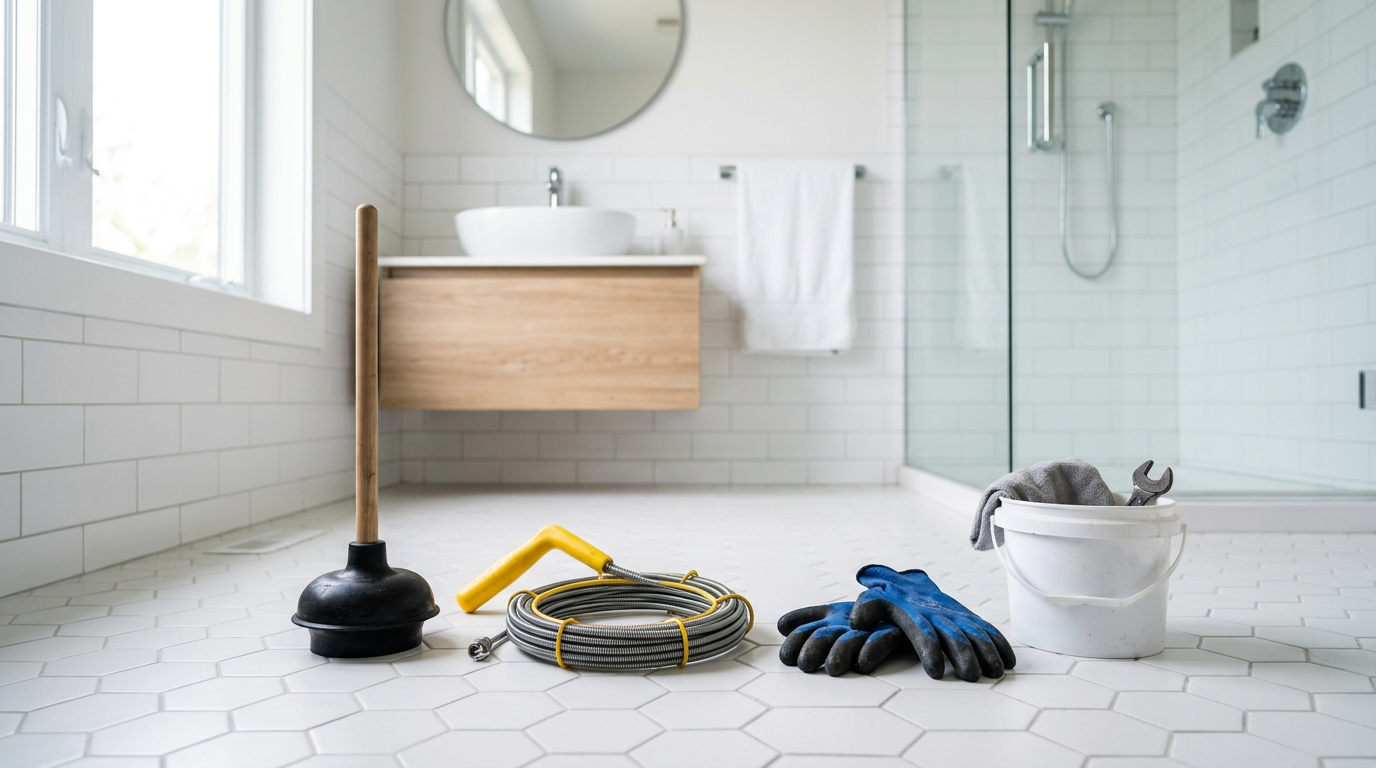
Anyone can unblock a drain — sometimes. The trick is knowing which blockages are a 10-minute DIY job, which ones need a professional, and which DIY methods actually cause more damage than they fix. Use this guide as a decision tree.
Step 1: Figure out what kind of blockage you have
Before you touch anything, ask yourself:
- Is it just one fixture slow or blocked? That’s a local blockage in the trap or the first metre of pipe — almost always DIY-able.
- Are multiple fixtures slow, gurgling or backing up? That means the blockage is further down in the shared stack or main drain — stop, because DIY from one fixture won’t help and can make it worse.
- Is sewage backing up into showers, floor wastes or toilets? Stop everything and call a plumber. This is a full main-line blockage and DIY efforts will generally push sewage further into the house.
Methods that work — in the right order
1. Boiling water (only for some kitchen drains)
For a slow kitchen sink blocked with fat or grease, a kettle of hot (not boiling) water, one sink full at a time, will often melt enough grease to clear it. Never pour boiling water down a porcelain basin, a toilet, or into PVC pipework — porcelain can crack and PVC can soften and deform at temperatures over 60°C. Hot tap water is safer.
2. Bicarb soda + white vinegar
Pour half a cup of bicarb soda, followed by a cup of white vinegar. Plug the drain. Wait 15 minutes. Flush with hot (not boiling) water. This works well for maintenance cleaning and mild soap/grease build-up, and it’s entirely safe for all pipe types. It won’t shift a real blockage — don’t expect it to.
3. A plunger (correctly used)
This is the single most effective DIY tool for 80% of one-fixture blockages, and most people don’t use it correctly. The rules:
- Block the overflow first with a wet cloth. Otherwise you’re plunging against an open airway and can’t build pressure.
- Fill the fixture with 5–10 cm of water so the plunger head is fully submerged — you’re trying to push water, not air, into the blockage.
- Push and pull sharply 15–20 times, keeping the plunger seated. The pull is as important as the push — the suction helps dislodge the blockage.
- Use the right plunger. A cup plunger for flat drains (sinks, basins). A flange or bell plunger (with the fold-out rubber lip) for toilets.
4. A hand drain snake / auger
For hair clogs in basin or shower drains, a cheap hand auger from any hardware store is remarkably effective. Feed it down the drain, twist as you push, keep going until you feel resistance, then hook the blockage and pull back. Expect it to come up looking horrific. Follow with hot water and a bicarb/vinegar flush.
5. A wet/dry vacuum (for small objects)
If something solid has fallen down the drain — a ring, a bottle cap, a kid’s toy — and it’s still near the top, a wet/dry vacuum on the outlet hose can sometimes suck it out before it travels further. Once it’s past the trap, you usually need the trap off to recover it.
Methods that look like they work but damage your pipes
1. Caustic drain cleaners (Drano and similar)
Yes, they’ll eat through hair and grease. They’ll also, over time, eat through rubber gaskets in joints, scale and crack older PVC pipe, and corrode chromed waste traps. They also create a soup of hot caustic liquid that then has to sit in the trap until someone dissolves the blockage further — which is a terrible thing to be plunging or dismantling later. Gold-standard plumbers avoid them entirely. For maintenance, use enzyme-based bio cleaners instead — they’re slower but don’t damage pipework.
2. DIY pressure cleaning / garden hose down the drain
Stuffing a garden hose down a drain and cranking the tap is an easy way to flood back up into the house. The hose has no return path for the water and no means of clearing the debris it pushes — it just shifts the blockage further down where it’s harder to reach.
3. Bending coat hangers past the trap
A bent coat hanger is fine for clearing hair from the strainer at the top of a shower drain. Pushed past the trap, it often gouges the inside wall of PVC pipe, snaps off, and becomes the new blockage. We’ve extracted a remarkable number of coat hangers from traps.
4. Using a plunger on a fixture with a vented overflow you didn’t block
All that happens is you spray sewage water out of the overflow slot above the sink. Block the overflow first.
5. Flushing “flushable” wipes
Not a DIY method — but worth stating: no wet wipe currently sold in Australia is actually flushable, regardless of what the packet says. Court decisions and Choice testing have confirmed this repeatedly. Wipes are the single biggest cause of blocked mains in Sydney after tree roots.
If you’ve tried the plunger and the auger and the blockage is still there — stop. More force rarely helps. You’re usually dealing with something further down the line that needs a drain jetter or camera.
When to stop and call a plumber
- Water backing up into other fixtures (multi-point blockage).
- Sewage smell coming up through floor wastes.
- A recurring blockage in the same drain despite cleaning (almost always tree roots — see our tree root guide).
- Gurgling from other fixtures when you run water in one (venting or partial main blockage).
- A solid object dropped past the trap that you care about recovering.
- Anything involving a toilet that can’t be cleared by plunging.
Tried the DIY and it didn’t hold? Southern Star Plumbing clears blocked drains right across Sydney — usually same day, with a camera inspection included in the quote for recurring jobs. Call 0432 304 609 or book online.