
The quick verdict for Sydney 2026
- Replacing an electric storage tank? Heat pump nearly always wins after rebates — the running-cost difference pays back the price gap quickly and keeps saving year after year.
- Replacing a gas continuous-flow unit? Like-for-like gas is the cheapest path. Heat pump still works long-term but the case is closer.
- Replacing an old gas storage unit? Either gas continuous flow or a heat pump — both better than another gas storage tank.
- No gas connection? Heat pump beats electric storage every time.
- Got rooftop solar PV? Heat pump on a daytime timer is brilliant — you’re effectively running it free.
Hot water is the second-biggest energy expense in most Sydney homes, behind heating and cooling. Choosing between a heat pump, a gas continuous-flow unit, an old-school gas storage tank or an electric storage tank is a 12–20 year decision — whatever you put in today is what you’ll be paying to run until your kids leave home. So getting it right matters.
This is the comparison we walk customers through every week, written without any brand sponsorships or upselling agenda. We sell whichever system is right for the house. Here’s how to figure that out.
How each system actually works (60-second version)
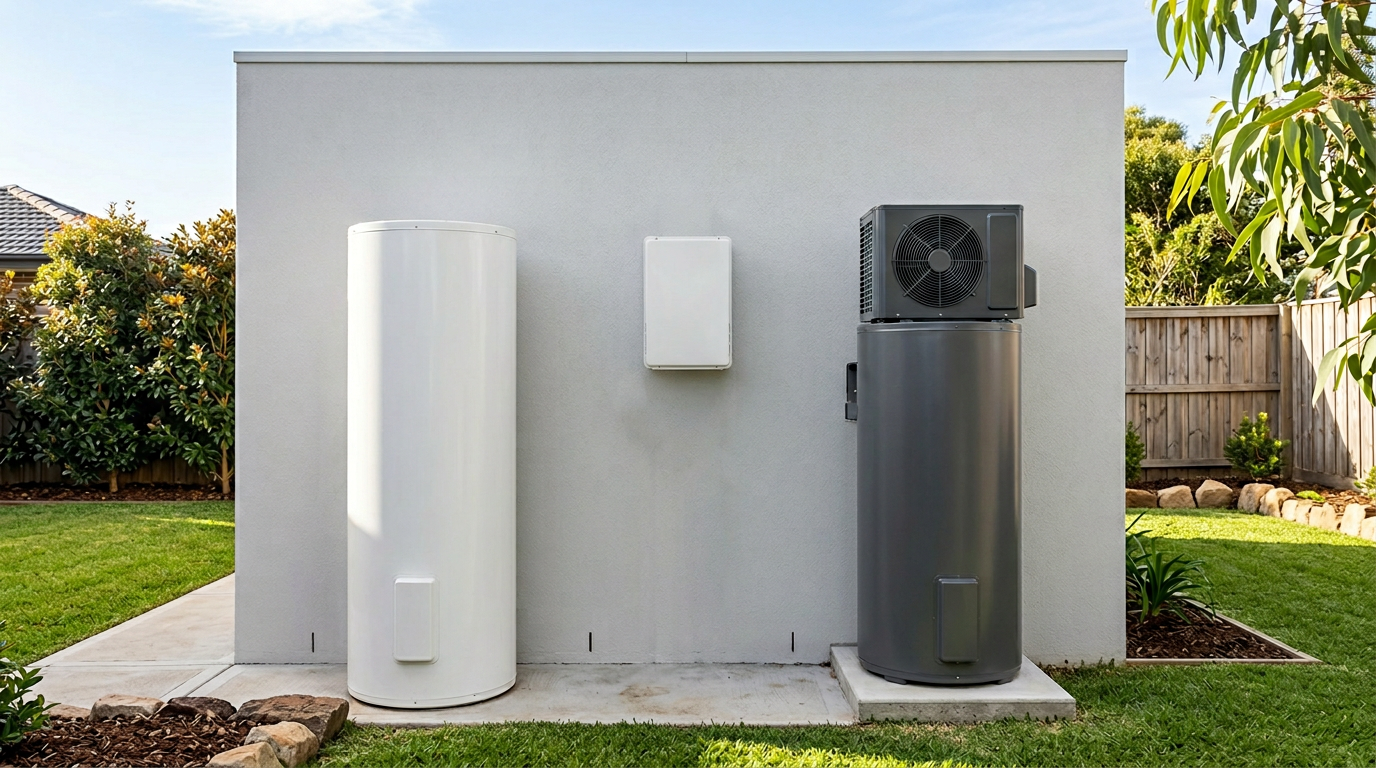
Electric storage — an insulated tank with a heating element inside. Cheap to buy, expensive to run. Heats water once, holds it at temperature, loses heat slowly to the room.
Gas storage — the same idea but a gas burner under the tank instead of an element. Faster recovery than electric, but tank standby losses still apply.
Gas continuous flow (also called “instant” or “tankless”) — a wall-mounted unit that fires up only when you turn a tap on, heating the water as it flows. No tank, no standby losses, endless hot water.
Heat pump — uses a refrigeration cycle (like a reverse air-conditioner) to extract heat from outdoor air and concentrate it into a water tank. Uses electricity to run the compressor and fan, but generates 3–4× more heat energy than the electricity it consumes — that’s the magic.
Solar hot water — rooftop panels heat water directly (or heat a glycol loop that warms the tank). Backed up by either an electric element or gas booster for cloudy days.
Side-by-side comparison
About the comparisons below
Where we mention running costs or upfront price differences, treat them as indicative directional comparisons only — actual numbers depend on your retailer’s tariffs, household usage, the brand and model installed, the rebate values current at the time, and your existing setup. Your installer can model the maths against your specific home; your energy retailer can confirm tariffs.
| Heat pump | Gas cont. flow | Gas storage | Electric storage | |
|---|---|---|---|---|
| Upfront install cost | Higher | Mid | Lower | Lowest |
| After rebates | Mid (rebates apply) | Mid (no rebate) | Lower (no rebate) | Lowest (no rebate) |
| Day-to-day running cost | Lowest of the four | Low | Medium | Highest (esp. continuous tariff) |
| Lifespan | 10–15 yrs | 15–20 yrs | 8–12 yrs | 10–15 yrs |
| Endless hot water? | Effectively yes (large tank) | Yes (true endless) | No (recovery time) | No (long recovery) |
| Footprint | Floor-standing, needs airflow | Wall-mounted, compact | Floor-standing | Floor-standing |
| Suits no-gas property | Excellent | No | No | Workable |
| Pairs with solar PV | Excellent | No | No | Workable on timer |
| CO₂ emissions (annual) | Lowest (esp. with solar PV) | Medium | Medium-high | High (unless 100% renewable plan) |
The 10-year running cost reality check
Upfront cost is only half the question. Across 10 years — the rough mid-life of any of these systems — the cumulative running cost typically dwarfs the install cost on every option except the heat pump. The clearest pattern Sydney homeowners see: a continuous-tariff electric storage tank ends up costing far more across a decade than the equivalent heat pump (sometimes by multiples), even after the heat pump’s higher install cost is factored in. The off-peak electric tank fares better than continuous, but is still a long way behind a heat pump.
Energy prices are also likely to rise over the next 10 years, which makes the heat pump case stronger, not weaker. If your home is on continuous tariff (white meter, no off-peak), the running-cost gap is widest of all and switching to a heat pump pays back the quickest. Your installer can put the maths on paper for your specific home before you commit.
The solar PV bonus that changes the maths
If you’ve got rooftop solar PV (and at this point most new Sydney builds do), running a heat pump on a daytime timer is close to free hot water. The heat pump draws around 1 kW of input for several hours during the daytime PV peak — energy you’re self-consuming rather than exporting at a low feed-in tariff. The day-to-day running cost compared with a continuous-tariff electric tank gets dramatically lower.
The Sydney-specific factors
Climate — do heat pumps actually work here?
Yes, comfortably. Sydney’s mean winter morning low across the metropolitan area is 5–8°C; even the colder parts of the upper Blue Mountains rarely sit below 0°C for long. Quality heat pumps (Sanden, Reclaim, Stiebel Eltron) are rated to operate at −7°C or lower with full output. Their published Coefficient of Performance (COP) drops from ~4.5 at 20°C ambient to ~3.0 at 7°C ambient — still 3× better than a resistive electric element. In real Sydney conditions a properly sized heat pump never struggles.
Gas mains availability
Most established Sydney suburbs have natural gas reticulated to the kerb. Newer outer-ring estates (parts of the Hills, far western Sydney, some northern beaches) have gone all-electric on new builds — you can’t install gas appliances without paying for a new connection that may not be available. If you’re in an all-electric area, the choice narrows to heat pump or electric.
Off-peak (Tariff 31)
If your existing electric storage system is on Sydney’s controlled-load off-peak tariff (Tariff 31, white meter), running cost is roughly half what it would be on continuous tariff. That helps the case for keeping electric storage if the unit is relatively new — but a heat pump on the same usage still beats it by 60–70%.
Apartments & strata
Many Sydney apartments have central gas hot water on common property. If you’re in a free-standing house or townhouse with individual hot water, all options are open. If you’re in a unit with shared hot water, replacement decisions sit with the strata committee, not the individual owner.
Reliability & lifespan
What goes wrong in each, in our experience across thousands of Sydney service calls:
- Electric storage — element burns out (5–10 yrs), thermostat fails (similar), tank corrodes through (10–15 yrs end of life). Anode rod replacement at year 5 doubles tank life.
- Gas storage — pilot/burner issues, thermocouple failure, gas valve, then tank corrosion. Fewer parts than electric so fewer service calls in the early years, but shorter overall life.
- Gas continuous flow — the most reliable category we install. Modern units (Rinnai Infinity, Rheem Metro) routinely make 18–20 years with simple servicing.
- Heat pump — compressor is the wear part. Quality brands hit 12–15+ years. Cheap imports often fail at 5–7 years and parts can be unavailable.
Best for — the household-by-household call
Family of four with natural gas connected
Pick: gas continuous flow (Rinnai Infinity 26 or Rheem Metro 26) or heat pump (Sanden, Reclaim) on a daytime timer if solar PV is installed. Both are excellent. The heat pump pulls ahead if you have or are getting solar PV; the gas continuous flow pulls ahead if you don’t and want simple, reliable, endless hot water.
Family of four with no gas
Pick: heat pump. The numbers are unanimous. A 270–315 L heat pump (Sanden Eco Plus 250 L is a 4-person workhorse) gives you near-endless hot water and runs at a third the cost of the equivalent electric tank.
Couple in a townhouse or duplex
Pick: gas continuous flow if gas is available (compact, wall-mounted, no tank), or a smaller (160 L) heat pump if not. Both fit small footprints.
Retiree couple, fixed income
Pick: heat pump (after rebates) if the existing tank is end-of-life. Lowest running cost matters most when income is fixed. The pensioner discount on labour helps too.
Granny flat or 1-bedroom unit
Pick: small (135–160 L) electric storage on off-peak or compact gas continuous flow if gas is available. Heat pump is overkill for very low daily demand — the rebate maths doesn’t favour a small heat pump as much as a large one.
Heritage home / tight install
Pick: gas continuous flow. Wall-mounted, smallest footprint, no airflow requirements. Heat pumps need a bit of clearance and an outdoor service area.
Off-grid or cabin (rural fringe of Sydney)
Pick: solar hot water with electric boost, or LPG continuous flow if no rooftop solar option.
Brand recommendations — what we install and why
We don’t take retainers from any manufacturer, so this is purely what we’ve found reliable on Sydney installs over the last decade.
- Heat pump: Sanden Eco Plus (Japanese, split system, 10-year tank warranty), Reclaim Energy (CO₂ refrigerant, very efficient), Rheem Ambiheat MPi/HSPL, Stiebel Eltron Accelera. All are CEC-approved and qualify for STC + NSW ESS rebates.
- Gas continuous flow: Rinnai Infinity 26 (the workhorse — outsells everything else 3:1 for good reason), Rheem Metro 26, Bosch Compress.
- Gas storage: Rheem Stellar (if you genuinely need gas storage), Dux Hottest.
- Electric storage: Rheem Optima/Stellar, Dux Proflo, Aquamax. All decent — pick whichever your installer can get to you fastest if you need same-day replacement.
- Solar: Apricus evacuated tubes, Rheem Loline.
The brands we don’t install
The heat pump market is flooded with cheap imports that look like a bargain on price. We avoid them because: compressor warranties are short (1–2 years), parts availability is patchy when something fails in year 4, many are not on the CEC approved list (so you forfeit the rebate), and the COP figures published often don’t hold up under independent testing. The brands we recommend all back the unit for at least 5 years on the compressor and 10 years on the tank.
The honest case for each system
Buy a heat pump if — you’re replacing an electric storage tank, you have or plan to install solar PV, you can fit it outdoors with airflow, you want the lowest running cost, and you plan to be in the home 5+ years. The maths is overwhelming.
Buy gas continuous flow if — you have natural gas, want endless hot water, value reliability and a 20-year lifespan, want minimal footprint, or live in a heritage property where outdoor heat-pump placement is awkward.
Buy gas storage if — you’re replacing an existing gas storage tank like-for-like in a tight space and the budget’s tight. Honestly though, gas continuous flow is usually the better choice now.
Buy electric storage if — you’re replacing a working off-peak tank in a rental or low-demand property, the existing setup is on Tariff 31, and the upfront cost is the dominant constraint. Otherwise, the heat pump pays back too quickly to justify electric storage in 2026.
Frequently asked questions
Which is cheaper to run — heat pump, gas or electric hot water?
Heat pump is typically cheapest in Sydney, followed by solar hot water, then gas continuous flow, then gas storage, then electric storage on off-peak, then electric storage on continuous tariff (which is by far the most expensive). Actual running costs depend on your retailer’s tariffs, household size and usage — your installer or energy retailer can model your specific home.
Do heat pumps work in Sydney winters?
Yes — Sydney’s coldest mornings are 5–8°C, well within the operating range of every quality heat pump (most rated to −7°C or lower). Efficiency drops a little on cold mornings but recovery time is barely affected for standard household demand.
Should I switch from gas to a heat pump in Sydney?
If you have natural gas connected and your gas continuous-flow unit is healthy, the running-cost gap is smaller and the case is less compelling. If you have an old gas storage unit due for replacement, a heat pump with stacked rebates often costs about the same as a gas continuous-flow replacement and runs at a third the cost — yes, switch.
What’s the lifespan of each hot water system type?
Electric storage 10–15 years, gas storage 8–12 years, gas continuous flow 15–20 years, heat pump 10–15 years (compressor lifespan-driven), solar 15–20 years on panels and 8–10 on the booster element. Replacing the anode rod at year 5 roughly doubles the life of any storage tank.
Are heat pumps noisy?
Modern heat pumps run between 38–50 dB at one metre — about the same as a quiet fridge or a domestic air-conditioner outdoor unit. They cycle (not constant) and most run quietest during the daytime ambient run. Locate them away from bedroom windows and you won’t hear them.
Can I install a heat pump where my old electric tank was?
Sometimes — but heat pumps need air clearance to work efficiently. Most need at least 300–500 mm clear above and around the unit, and they push out cool air, so under-eaves or alongside an outdoor area is best. They also need power and condensate drainage. A pre-install site visit confirms whether it fits or needs relocating.
Want a recommendation tailored to your specific home? Tell us your suburb, current setup, household size and whether you have solar PV — we’ll send back a written quote with exact rebate value calculated, plus the option we’d genuinely choose for your property. Call 0432 304 609 or request a free quote.
Want the buyer’s guide on pricing? See our Hot Water System Cost Sydney 2026 guide for the line items every honest quote should include and how the rebate schemes work.