
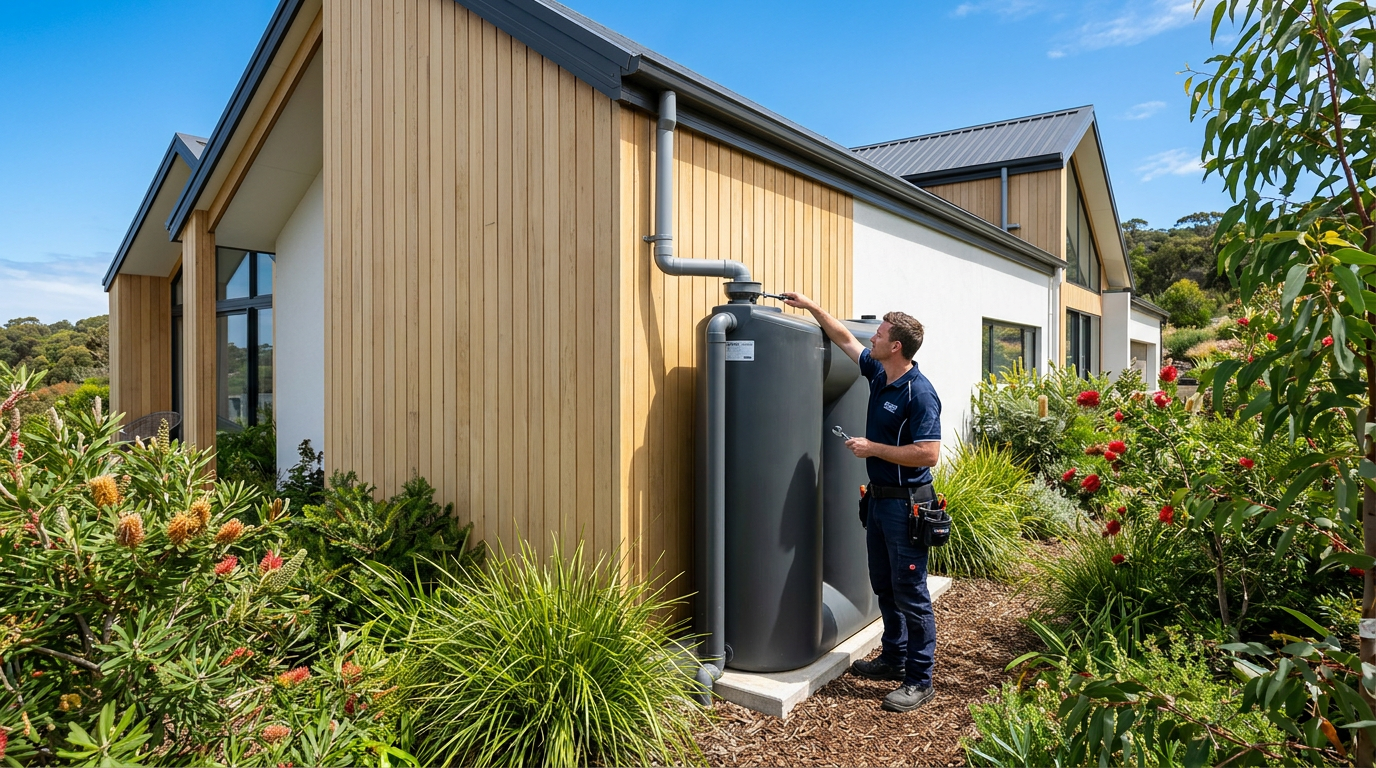
Sydney receives around 1,200mm of rain a year — more than London, Paris or New York — and almost all of it runs off roofs and into stormwater within minutes of hitting the ground. A properly installed rainwater tank captures a useful fraction of that and puts it to work flushing toilets, running washing machines and keeping gardens green. Here’s what you actually need to know before committing to one.
Why bother with a rainwater tank?
- Water bill savings. A well-sized tank connected to toilets, laundry and garden can take a meaningful chunk off the annual Sydney Water bill — the actual saving depends on rainfall, your roof catchment area and what you connect the tank to.
- BASIX compliance. New builds and major renovations in NSW must meet BASIX water targets — a rainwater tank is one of the cheapest ways to do it.
- Drought resilience. Sydney’s gone through multiple Level 2 restrictions in the past decade. A tank means you can water a garden even when the mains are restricted.
- Better stormwater outcomes. Every litre going into a tank is a litre not overloading local creeks. Some councils factor this into stormwater charges.
- Resale value. Research from CoreLogic and the NSW Department of Planning consistently shows sustainability features add 1–3% to median sale prices in Sydney.
How big a tank do you actually need?
This is the question that separates a tank that pays for itself from one that sits empty half the year. Two numbers matter:
1. Your catchment area (roof square metres connected to the tank)
Every 1mm of rain on 1m² of roof = 1 litre into the tank (minus ~10% for evaporation and first-flush diverters). A typical Sydney 4-bedroom home has 150–220m² of roof, which in Sydney’s rainfall would generate around 150,000–230,000 litres a year if 100% captured.
2. Your target uses
Toilet flushing (~20% of household water), cold water to the laundry (~15%), and garden use (~25% seasonally). Covering just toilet and laundry is usually the sweet spot for cost vs. benefit in Sydney — about 35–40% of household water use.
For most Sydney 3–4 bedroom homes connected to toilets, laundry and garden, a 3,000–5,000 litre tank is the practical sweet spot. Smaller than that and you’ll run dry too often between rainfall events; larger than that and you’re rarely using the capacity. Slimline steel tanks (typically 2,000–3,000L) fit along side boundaries where a round tank won’t.
Council rules and permits in Sydney
Good news — in most NSW local council areas, installing a rainwater tank is exempt development under the State Environmental Planning Policy (Exempt and Complying Development Codes) 2008, provided:
- The tank is above ground.
- It’s no more than 3m high and within specified setbacks from boundaries (usually 450mm side, 900mm front).
- Total capacity is less than 10,000L in most residential zones.
- It doesn’t drain to a neighbour’s land or cross a boundary.
- The installation is done by (or signed off by) a licensed plumber, with a Notice of Work and Certificate of Compliance lodged with Sydney Water if connected indoors.
Heritage listed properties, strata schemes and properties with side setback issues may need a formal DA — worth confirming with your local council before committing.
What a proper Sydney installation includes
A compliant rainwater tank install is more than just dropping a tank on a base. A proper job includes:
- A level, engineered base — either a concrete slab or a crushed-rock pad with a plastic tank mat. A full 5,000L tank weighs 5 tonnes; DIY base preparation is the #1 cause of tank failures and leaks.
- First-flush diverter on each downpipe connection — diverts the first few litres of any rain event (which carries most of the roof debris and bird droppings) away from the tank.
- Leaf screens and a mosquito-proof inlet strainer (AS/NZS 4020 compliant).
- An overflow sized for the worst-case storm event, connected to stormwater.
- A tank pump with a switchable-supply controller — automatically switches to mains water if the tank runs dry, and is required if the tank is plumbed into toilet or laundry.
- Backflow prevention between the rainwater system and the mains (dual check valve minimum) — see our backflow guide.
- A dedicated rainwater label on every indoor rainwater outlet per AS/NZS 3500.
What drives the cost of a Sydney installation
Rainwater tank installs vary widely in cost — the biggest variables are tank size and material (slimline poly is cheapest, round poly is mid-range, steel costs more, underground tanks are the most expensive by a wide margin), access (can the tank fit through the side of the property without a crane?), base preparation, and the complexity of the indoor connection. Connecting just the laundry cold tap is straightforward; getting rainwater up to a second-storey toilet is not. We provide a written, itemised quote after a quick site visit so you can see the breakdown.
NSW rebates and incentives in 2026
Federal and state rebate programs change year to year. In 2026, the main opportunities in Sydney are:
- Local council rebates. A handful of Sydney councils (City of Sydney, Waverley, Woollahra, and Northern Beaches among others) run rainwater tank rebate or subsidy programs — the value and eligibility depend on the council and the tank size. These change annually; check your council’s sustainability page before ordering.
- Sydney Water WaterFix Plus. Concession card holders can access free fixture upgrades and sometimes rainwater tank assistance.
- BASIX offsets for new builds/renos. Not a cash rebate, but counts towards meeting BASIX compliance, saving you from having to spend on other water-saving upgrades.
- Strata incentives. Some strata schemes offer rebates for owner-installed water-saving upgrades — worth asking your strata manager.
Any rebate you claim will almost always require a licensed plumber’s compliance certificate. Don’t skip the certificate to save a small amount on the install — you’ll lose far more on the rebate and any future insurance claim.
Maintenance — the bit nobody talks about
A tank is not install-and-forget:
- Clean gutters twice a year. Gutter debris is the #1 contaminant of tank water.
- Clean first-flush diverters every 3–6 months.
- Inspect inlet screens and mosquito-proofing annually.
- De-sludge the tank every 2–3 years — a plumber with a wet-vac can do this in an hour.
- Pump servicing every 2–5 years or as manufacturer specifies.
Should you DIY it?
You can legally install a rainwater tank yourself in NSW if it’s only feeding a garden hose or sprinkler — no mains or potable connections. Any internal connection (toilet, laundry, hot water) or any mains backup must be installed or signed off by a licensed plumber, with the Notice of Work and Compliance Certificate lodged with Sydney Water. Trying to connect indoors yourself will void your home insurance and can trigger an order from Sydney Water to remove it.
Looking at a tank for your place? Southern Star Plumbing quotes and installs rainwater systems across Sydney — slimline to underground — and handles all BASIX and Sydney Water compliance paperwork. Call 0432 304 609 or request an on-site assessment.